A Trip on The Wherry Line: From Lowestoft to Norwich
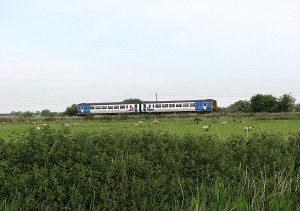
Lowestoft is one of two sea-side termini on the Wherry line, the other being Great Yarmouth. It is the mostly easterly station on the UK rail network and is the most easterly point of the United Kingdom.
With the fishing industry finished here and tourism significantly declined, the local economy is not strong, and whilst the area was important in maintaining North Sea Oil services, that activity has also declined sharply.
Today the hope is to expand the wind farm support services to help both the Great Gabbard offshore windfarm and another windfarm that is now being proposed.
The route to Norwich first takes you past miles of old sidings on the left side, where the herring van trains would wait to be loaded from the many herring fishing boats, which would have been seen on the wharves behind the sidings. Sidings on the other side of the track would have stored the passenger carriages for all the tourists brought in by train from London & the Midlands. All this is gone now.
Pretty quickly the train arrives at Oulton Broad North.
Oulton Broad North is often the only stop on the way to Norwich.
The line leaves Oulton and very soon is running alongside the River Waveney for a couple of miles before reaching Somerleyton station. This is the stop for Somerleytom Hall, if required, but care needs to be taken as to which train you take as many do not stop here.
The Somerleyton Estate covers some 5,000 acres and includes the Grade 2* Somerleyton Hall. The rail line then crosses over the River Waveney via a swing bridge and runs alongside navigable canals passing through the low lying landscape. Aside from the many cattle you will see here, you are likely to see swans, gulls and herons along the way.
The next station you will see, but may not stop at, is Haddiscoe. The line is over a mile away from the village but almost immediately after leaving the station you will see the beginning of the Haddiscoe cut, the canal which links the River Waveney and the River Yare.
The line runs alongside this canal for a couple of miles before it slowly curves away from the canal so as to turn back to cross the River Yare just before the link with the canal. Again this crossing is via a swing bridge that the train will cross very slowly.
Just after a rail junction with a line to Great Yarmouth the route arrives at Reedham station, although a lot of trains do not stop there. The route then continues through a more agricultural area until it reaches Cantley station, just after passing the first UK sugar beet factory, built in 1912. Today it is one of just four sugar beet factories in the UK.
By now the River Yare is to the south of the railway and along the route you will get glimpses of the river, tributaries and inlets all the way to Norwich. You will also see a number of boatyards, marinas and a lot of Norfolk Broads pleasure craft.
The next station will be Buckenham and very few trains stop here apart from a few, request only, at weekends. This station is one of the least used on the whole rail network with only 106 people using it in 2010/11. Those who would have used it were either ramblers or bird watchers, as the station is next to RSPB Buckenham Marshes and is near to RSPB Strumpshaw Fen and Strumpshaw Hall Steam Museum for traction engines and the like.
Just before the next station the other Wherry line route, from Great Yarmouth to Norwich, joins this line. The Station is Brundall. This station has one of the very few manually operated level crossings. The crossing keepers hut is out of site.
By now the landscape is getting a little more inhabited with some lovely houses abutting the water, both the River Yare and various creeks, often again populated with many pleasure craft.
Soon you will pass Brundall Gardens and before long the track links up with that of the Bittern Line from Sheringham to Norwich. Now the surroundings are built up and soon you will see the Crown Point carriage sidings and maintenance sheds for the Norwich terminus where the Bittern, Wherry, London and Liverpool lines all terminate. Many years ago this was the site of the circus train unloading siding.
Then the train will ease its way into the Norwich terminus. This was originally one of three stations in the city. It opened in 1844 under the name of Norwich Thorpe which it kept until Norwich City closed in 1959 and Norwich Victoria finally closed in the 1970s.
Related Articles
Southwold - An Introductory, Historical Guide
Full of character and interest both to the holidaymaker and the historian, Southwold i...
Introducing Thorpeness
Thorpeness, hugging its bit of coastline between Aldeburgh and Leiston, is a mixture...
Woodbridge: An Introduction on Foot
The ancient market town of Woodbridge was once a major ship building town providing f...
A Stroll Around Beccles
Beccles is the largest town in the Waveney area, at the southernmost point of the Bro...
A Day out in Manningtree & Mistley
Located side by side on the south side of the Stour - at the point where the river st...
Shingle Street: An Introduction
A single row of assorted cottages stands sentinel against the ravages of the North Sea whose...