A Short Introduction to Eye
Eye is a small market town in the north of Suffolk, a short distance from Diss and just half an hour’s drive from Norwich. It is situated beside the River Dove and close to the River Waveney, which forms the border with Norfolk.
The town of Eye derives its name from the Old English word for 'island' and it is believed that the first settlement on the site would have been almost entirely surrounded by water and marshland, formed by the River Dove and its tributaries.
Eye remains one of the tiniest towns in Suffolk. It was once the smallest borough in the country, its claim based on the 1205 Charter of King John. In 1974 it became a civil parish, retaining a Town Council, a Mayor and the insignia.
Historical Eye
There have been Palaeolithic, Mesolithic, Neolithic and Bronze Age finds in and around Eye, but the earliest evidence of settlement in the town dates back to the Roman period. In 1781 some labourers unearthed a lead box close to the river containing around 600 Roman gold coins, some dating back to the reigns of Valens and Valentinian; the largest hoard of Roman gold coins ever discovered in Britain. 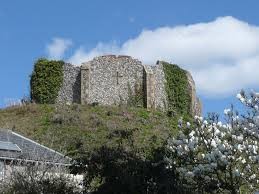
The importance of the town was firmly established after the Norman Conquests when the Honour of Eye was granted to William Malet, a Norman Lord. Between 1066 and 1071, Malet constructed a castle, to establish his military and administrative headquarters, and started a highly successful market.
Having endured many battles, the castle became a prison in 1215 and continued to be used as such until the 17th century, but over time the locals helped themselves to the stone and by 1370 Eye Castle was described as worthless.
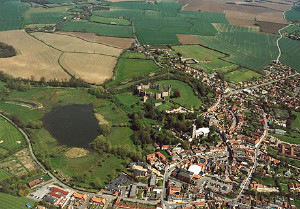
The castle has had close associations with royalty from the time of The Battle of Hastings in 1066, and was probably used as a defensive site for many centuries before that. Now, rather than dominating the surrounding area with military might, the castle offers a tranquil setting.
In 2013 major restoration works were put in place and a new on site interpretation outlines the story of the rise and fall of the castle and links it to national events, including the Battle of Waterloo. Standing atop the motte you have panoramic views of Eye, with its magnificent 15th century church, quaint cottages and Victorian town hall.
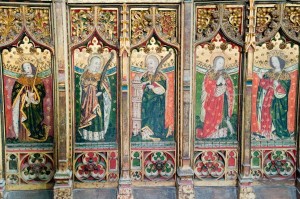
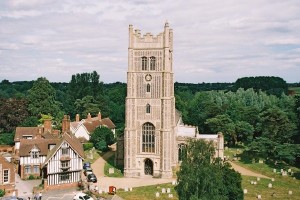
The 14th century Church of St Peter and St Paul is considered to be one of the finest churches in the county. A 13th century Early English Period doorway, from a former building, was retained in the construction of the church and in the 15th and 16th centuries, there were periods of new work and renovation, including the installation of an Altar Tomb to William Honnyng in the South or Lady Chapel and one to Nicholas Cutler to the north west of the nave. The church was restored in 1868 by James Colling, a London architect.
A particular feature of the church is the magnificent late 15th century rod screen with intricate carving, and paintings of kings, saints and bishops. Although the paintings have faded they have been partly restored and give an idea of the brilliant colours that would have been seen in the Middle Ages.
Eye was once busy with lace making. In 1673 the town records declare that 'the women's employ in this town is making of bone lace' and in 1830, 'the humbler class of industrious females employ themselves in lace making'. The last lacemaker in the town died at the start of World War One.
Famous Connections
Sir Frederick Ashton (1904-1988), choreographer with The Royal Ballet, lived at Chandos Lodge in Eye. Janet Frame (1924-2004), the New Zealand author, lived for a short period in 1963-64 in a rented cottage in Braiseworth, near Eye, where she began her novel An Adaptable Man, inspired by the local area, with Eye being fictionalised as 'Murston'.
Eye Today
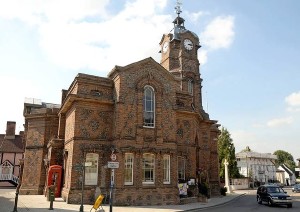
Well worth a visit, the pretty town of Eye has a delightful Italianate Town Hall, built in 1857, with a clock tower once used to incarcerate its local criminals!
There are many unusual and interesting buildings, and a first class weekly country market.
Eye has an excellent range of independent shops, including several fascinating antique and interiors shops, a gift shop, a deli, a good butchers, as well as several convenience stores. The chocolate shop is a delight!
 Nearby...
Near Eye is Thornham Estate, which offers walkers 12 miles of marked footpaths (some surfaced for wheelchairs and pushchairs) that wind through beautiful countryside, ancient parkland, farmland and woodland. Look out for Thornham’s spectacular giant wood carvings, which are hidden throughout the wood, or the estate’s Victorian walled garden.
A trip to Redgrave and Lopham Fen Nature Reserve should not be missed; home to rare (and enormous) raft spiders, you can see a superb selection of wildlife including Konik ponies which graze the reserve, the largest river valley fen in England.
A short drive from Eye is Henry Watson’s Potteries and Tearoom, a family run ceramics company more than two centuries old. Watson’s makes iconic, rustic-style kitchenware that can be seen in homes across the country.
Visit the annual Eye Show and Country Fair on August Bank Holiday. Inaugurated in 1915 the Eye Show has outgrown its original site and now takes place a few miles outside the town, near Palgrave just off the A143. For up to date information see www.eyeshow.org.uk
Stay in Eye: Thatched Cottage, a delightful and spacious thatched house with original features, sleeps 5.
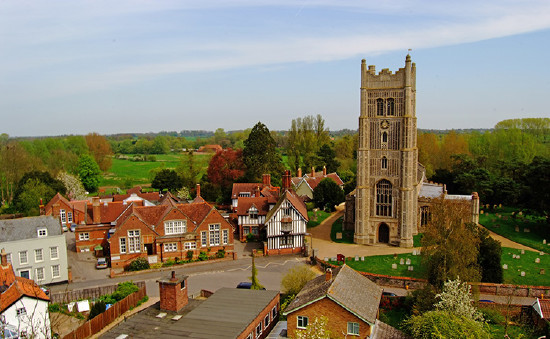
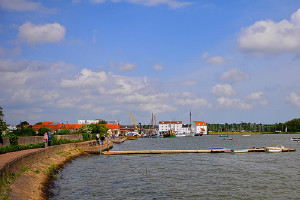
Main image by Chris Downer, source: Wikimedia; castle image, source: British Listed Buildings; church & village image, source: Eye Parish Church.
Related Articles
Southwold - An Introductory, Historical Guide
Full of character and interest both to the holidaymaker and the historian, Southwold i...
Introducing Thorpeness
Thorpeness, hugging its bit of coastline between Aldeburgh and Leiston, is a mixture...
Woodbridge: An Introduction on Foot
The ancient market town of Woodbridge was once a major ship building town providing f...
A Stroll Around Beccles
Beccles is the largest town in the Waveney area, at the southernmost point of the Bro...
A Day out in Manningtree & Mistley
Located side by side on the south side of the Stour - at the point where the river st...
Shingle Street: An Introduction
A single row of assorted cottages stands sentinel against the ravages of the North Sea whose...